
Will AI Take Your Marketing Job? Here’s What the Future Looks Like
Introduction
Artificial Intelligence (AI) is transforming the way businesses operate, communicate, and connect with customers. From automated customer support to personalized advertisements, AI has become an important part of modern digital marketing. Today, marketers use AI-powered tools to create content, analyze customer behavior, improve advertising campaigns, and save time on repetitive tasks.
As AI technology continues to develop, many digital marketers, students, and professionals are asking an important question: Will AI take your marketing job?
The increasing use of AI has created both excitement and uncertainty in the marketing industry. Some people believe AI will replace many traditional marketing jobs, while others believe it will create new opportunities for professionals who know how to use it effectively.
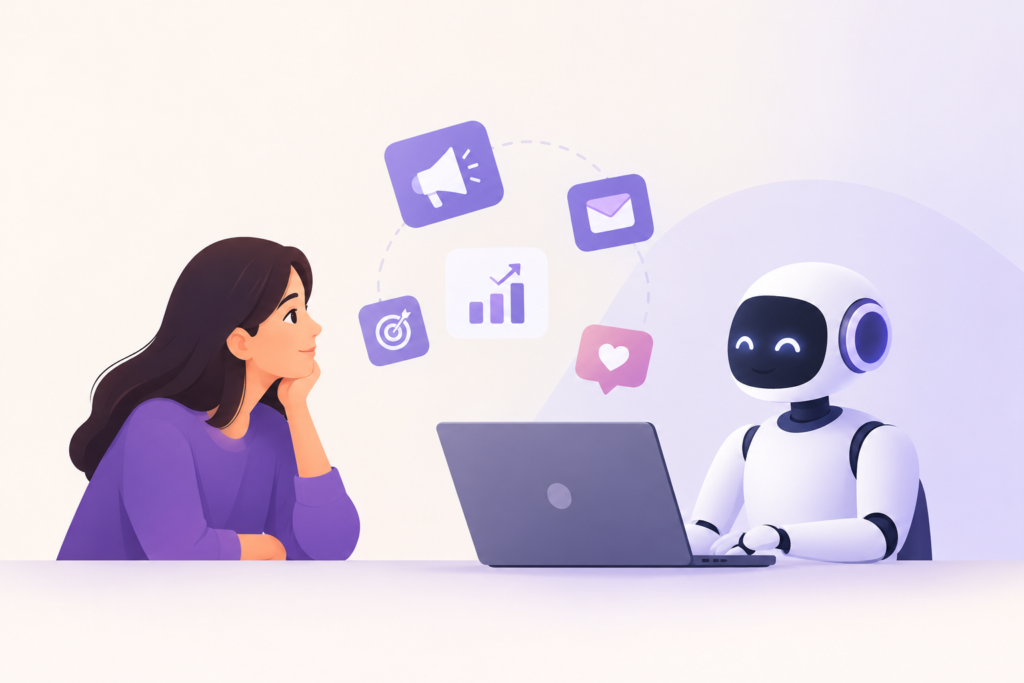
The reality is that AI is changing marketing jobs rather than simply eliminating them. Certain tasks can now be automated, but creativity, emotional intelligence, strategic thinking, and human understanding remain essential. The future of digital marketing will depend on how effectively humans and AI work together.
In this blog, we will explore how AI is changing digital marketing, which jobs may be affected, the skills marketers need to develop, and what the future of marketing could look like.
1. Understanding the Role of AI in Digital Marketing
AI refers to technology that enables computers and software to perform tasks that usually require human intelligence. These tasks include analyzing information, recognizing patterns, generating content, and making predictions.
In digital marketing, AI helps businesses understand customers and make data-driven decisions.
Some common applications of AI in marketing include:
- Content creation: AI tools can generate blog outlines, social media captions, email drafts, and advertising copy.
- Customer analysis: AI can analyze customer data to identify interests, preferences, and purchasing patterns.
- Chatbots: AI-powered chatbots can answer common customer questions and provide support.
- Advertising optimization: AI can help identify audiences, automate bidding, and improve advertising performance.
- Email marketing: AI can assist with audience segmentation, personalized messages, and campaign timing.
- SEO assistance: AI tools can help marketers research keywords, organize content, and identify search trends.
These applications allow marketers to complete many tasks more efficiently. However, AI-generated results still require human review, particularly when accuracy, brand reputation, and customer trust are involved.
2. Which Marketing Tasks Can AI Automate?
One of the biggest advantages of AI is its ability to automate repetitive and time-consuming tasks. This allows marketing professionals to spend more time on planning, creativity, and business development.
Content creation and editing
AI writing tools can generate first drafts of blog posts, product descriptions, email newsletters, and social media content. They can also suggest headlines and improve grammar.
However, AI-generated content may lack originality, emotional depth, and a genuine understanding of a particular audience. Human marketers are still needed to verify information, develop unique ideas, and ensure that content reflects the brand’s voice.
Data analysis and reporting
Digital marketers often work with large amounts of information, including website traffic, customer engagement, and advertising results.
AI can process this information quickly and identify patterns that may be difficult to notice manually. It can help marketers understand which campaigns are performing well and where improvements may be needed.
Marketers must still interpret these findings and decide what actions make sense for their business.
Customer service
AI chatbots can respond to frequently asked questions, provide basic product information, and guide customers through simple processes.
This can reduce waiting times and improve customer support availability. However, complicated complaints, sensitive situations, and unusual customer needs may require human assistance.
3. Will AI Replace Digital Marketing Jobs?
AI may change the responsibilities of many marketing professionals, but its impact will not be the same across every role.
Some tasks are easier to automate than others. Jobs that involve repetitive work, predictable processes, and large-scale data processing may experience greater changes.
For example:
- SEO specialists may use AI for keyword research, content analysis, and reporting.
- Content writers may use AI to generate ideas and prepare initial drafts.
- Social media managers may use AI to plan posts, analyze engagement, and organize content calendars.
- Email marketers may use AI for audience segmentation and personalization.
- Digital advertising specialists may use AI-powered systems to optimize campaign delivery and bidding.
This does not mean that every professional in these roles will lose their job. Instead, the work may shift toward activities that require judgment, creativity, communication, and strategic decision-making.
Businesses still need people who understand their customers, define marketing goals, evaluate campaign results, and take responsibility for important decisions.
4. Why Human Creativity Still Matters
Although AI can generate content and suggest marketing ideas, human creativity remains an important part of successful marketing.
Marketing is not only about producing advertisements or publishing social media posts. It is also about understanding people, building relationships, and communicating meaningful messages.
Human marketers bring experiences, emotions, cultural awareness, and personal perspectives that help them connect with audiences.
For example, a company launching a new product needs more than attractive advertisements. It must understand what customers care about, identify the problems the product solves, and communicate its value in a relatable way.
AI can assist with research and content development, but human marketers need to shape the overall message and ensure it reflects the company’s values.
Creativity is not simply about producing more content. It is about creating meaningful connections with people.
5. The Importance of Human Judgment and Emotional Intelligence
Successful marketing requires an understanding of human emotions and behavior.
Customers may make purchasing decisions based on trust, personal experiences, cultural values, and emotional connections. These factors can be difficult to understand fully through data alone.
Human marketers can consider context, recognize sensitive situations, and adapt communication when circumstances change.
For example, if a company faces a customer complaint or a public relations issue, a marketer must respond carefully. An automated response may provide basic information, but a thoughtful human response can demonstrate empathy and accountability.
Human judgment is also important when reviewing AI-generated content. Marketers need to identify misleading claims, inappropriate language, biased outputs, and information that could damage customer trust.
As AI becomes more common, professionals who combine technical knowledge with emotional intelligence will have important responsibilities.
6. New Career Opportunities Created by AI
AI is not only changing existing marketing roles; it is also creating demand for new combinations of skills.
As businesses adopt AI-powered marketing systems, professionals may find opportunities in areas such as:
- AI marketing specialist: Using AI tools to improve marketing workflows and campaign performance.
- Marketing automation specialist: Designing automated customer journeys and communication processes.
- AI content strategist: Planning and reviewing AI-assisted content while maintaining brand quality.
- Marketing data analyst: Interpreting marketing data and turning insights into business recommendations.
- AI-powered SEO specialist: Combining SEO knowledge with AI-assisted research and optimization.
- Marketing technology consultant: Helping businesses select, implement, and manage marketing technologies.
The exact job titles and responsibilities vary between organizations. Some of these roles build on existing marketing careers rather than representing entirely new professions.
The important point is that AI adoption creates opportunities for professionals who can connect technology with real business needs.
7. Essential Skills Marketers Need in the AI Era
To prepare for the future of digital marketing, professionals should focus on developing a combination of technical and human skills.
AI tool proficiency
Marketers should learn how to use relevant AI tools for research, writing, analytics, automation, and campaign planning.
Understanding how to use these tools responsibly can improve productivity and help professionals complete tasks more effectively.
Creativity and storytelling
Brands need original ideas and engaging stories to stand out in a competitive digital environment.
Marketers should develop their ability to communicate clearly, understand audiences, and create content that feels relevant and authentic.
Data analysis
Understanding marketing metrics is essential. Professionals should learn how to interpret website traffic, conversion rates, engagement, and advertising performance.
AI can provide insights, but marketers need to understand what those insights mean for their business.
Critical thinking
AI-generated information is not always accurate or appropriate. Marketers must evaluate results, verify facts, and make informed decisions.
Communication and collaboration
Marketing often involves working with designers, developers, sales teams, business owners, and customers. Strong communication skills help professionals coordinate their work and explain their ideas.
Continuous learning
AI technology changes rapidly. Marketers should regularly update their knowledge, experiment with new tools, and learn from practical experience.
8. How Students and Beginners Can Prepare for the Future
Students and beginners entering digital marketing may feel uncertain about how AI will affect their career opportunities. However, learning digital marketing fundamentals alongside AI tools can help them build a useful foundation.
Here are some practical steps to get started:
- Learn the basics of SEO, social media marketing, content marketing, email marketing, and digital advertising.
- Explore AI tools that support writing, research, design, and analytics.
- Create personal projects, such as a blog, social media page, or sample advertising campaign.
- Build a portfolio that demonstrates your skills and explains the work you have completed.
- Practice interpreting campaign data and identifying opportunities for improvement.
- Learn to fact-check AI-generated content and understand its limitations.
- Follow developments in digital marketing and continue improving your skills.
Practical experience is particularly valuable because it helps students understand how marketing concepts work in real situations.
Instead of learning only how to use a tool, beginners should focus on understanding the marketing problem that the tool is supposed to solve.
9. The Future of Digital Marketing: Humans and AI Working Together
The future of digital marketing is likely to involve closer collaboration between people and AI systems.
AI can help marketers research audiences, generate initial content, process information, and automate routine activities. Human professionals can then focus on strategy, creativity, customer relationships, and evaluating the quality of the results.
For example, when planning a social media campaign, AI can suggest content ideas and help analyze previous engagement. A human marketer can select the ideas that fit the brand, adapt the messaging, and decide how to communicate with the target audience.
This combination can make marketing workflows more efficient while keeping human judgment involved.
However, AI adoption also brings challenges. Businesses must consider customer privacy, data security, accuracy, copyright concerns, and the responsible use of automated systems.
The future will not depend only on how advanced AI becomes. It will also depend on how businesses choose to use it and how professionals adapt to changing responsibilities.
10. Challenges and Limitations of AI in Marketing
Despite its advantages, AI has several limitations that marketers should understand.
Lack of genuine human experience: AI can generate emotional language, but it does not have personal experiences in the same way people do.
Possibility of inaccurate information: AI tools can produce incorrect or misleading information, making fact-checking essential.
Generic content: Depending on the instructions and information provided, AI-generated content may sound repetitive or lack a distinctive brand voice.
Privacy concerns: Using customer information in AI systems requires careful attention to data protection and applicable privacy requirements.
Overdependence on technology: Businesses that rely entirely on automated outputs may overlook customer needs, creative opportunities, or important contextual details.
Understanding these limitations allows marketers to use AI more responsibly and make better decisions about which tasks should be automated and which require human involvement.
Conclusion
So, will AI take your marketing job? The answer is more complex than a simple yes or no.
Artificial Intelligence is changing digital marketing by automating repetitive tasks, improving data analysis, supporting content creation, and transforming advertising processes. These developments may change the responsibilities of existing marketing professionals and affect demand for certain types of work.
At the same time, marketing continues to require creativity, strategic thinking, communication, emotional intelligence, and an understanding of human behavior. AI can support these activities, but businesses still need people to guide decisions, evaluate results, and build meaningful customer relationships.
For students and professionals, the key is to develop skills that combine marketing knowledge with technological understanding. Learning AI tools, gaining practical experience, improving analytical abilities, and continuing to adapt can help marketers prepare for changing workplace expectations.
The future of digital marketing is not just about AI replacing people. It is about how people use AI to transform the way they work.
Rather than fearing every new technological development, marketers can focus on understanding AI, exploring its possibilities, and learning how to use it responsibly.
Ultimately, the future of your marketing career will depend not only on the technology available but also on your willingness to learn, adapt, and bring valuable human skills to your work.